- Merito
- Posts
- signed on to UCP?
signed on to UCP?
Your Shopify store is already live in ChatGPT
D2C x GEO(Generative Engine Optimization)
Hey readers,
Welcome to the twentieth edition of D2C Cents!
TLDR - We are your scroll-friendly, no-fluff download of what's shaping India's D2C brands.

This edition? We talk about:
Why your Shopify store is already live inside ChatGPT (yes, right now)
The protocol war that's rewiring how the entire internet shops
What Indian D2C founders need to do in the next 72 hours
March 24, 2026, while you were sleeping, Shopify made a decision. 5.6 million online stores became shoppable inside ChatGPT. Including yours, if you're on Shopify. You didn't opt in; you were just added by default.
If you sell online, your products are now living inside AI conversations you can't see, track, or control. AI is deciding whether to show your product or your competitor's, and you have zero say in it.
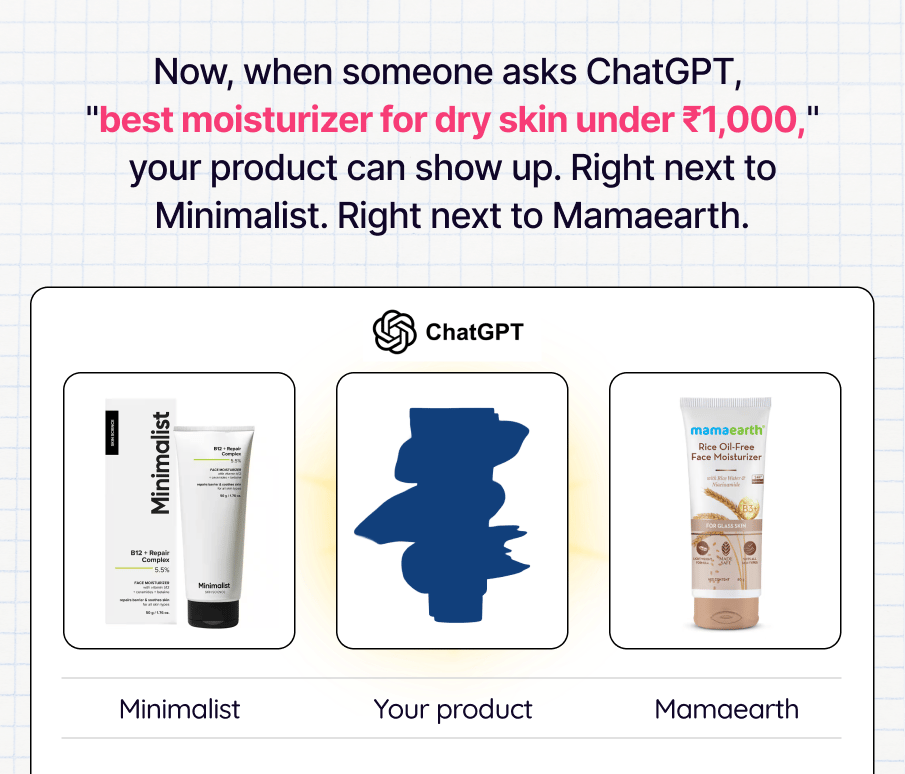
Now you might be thinking they have ₹50 crore in funding, and you have none.
But product data quality matters more than brand budget now. A ₹10 lakh/year brand with clean catalog data can outrank a ₹100 crore unicorn with lazy descriptions.
And if you're an Indian D2C brand still optimizing for Instagram engagement, you're about to get left behind.
What Just Happened?
In the last 90 days, the "Buyer Journey" has been compressed into a single chat bubble.
Someone asks ChatGPT, "best moisturizer for dry skin under ₹1000."
The AI surfaces 3-4 products → complete with images, prices, and reviews → the buyer clicks → they land on YOUR store to checkout.
You keep the customer, you keep the data, you keep the relationship.
Four channels went live simultaneously: ChatGPT, Microsoft Copilot, Google AI Mode, and Gemini. You control all four from one toggle in Shopify Admin. Except Indian brands aren't on Shopify, they're on Shopify knock-offs, WooCommerce, or custom-built garbage that hasn't been updated since 2019.
Current fee structure:
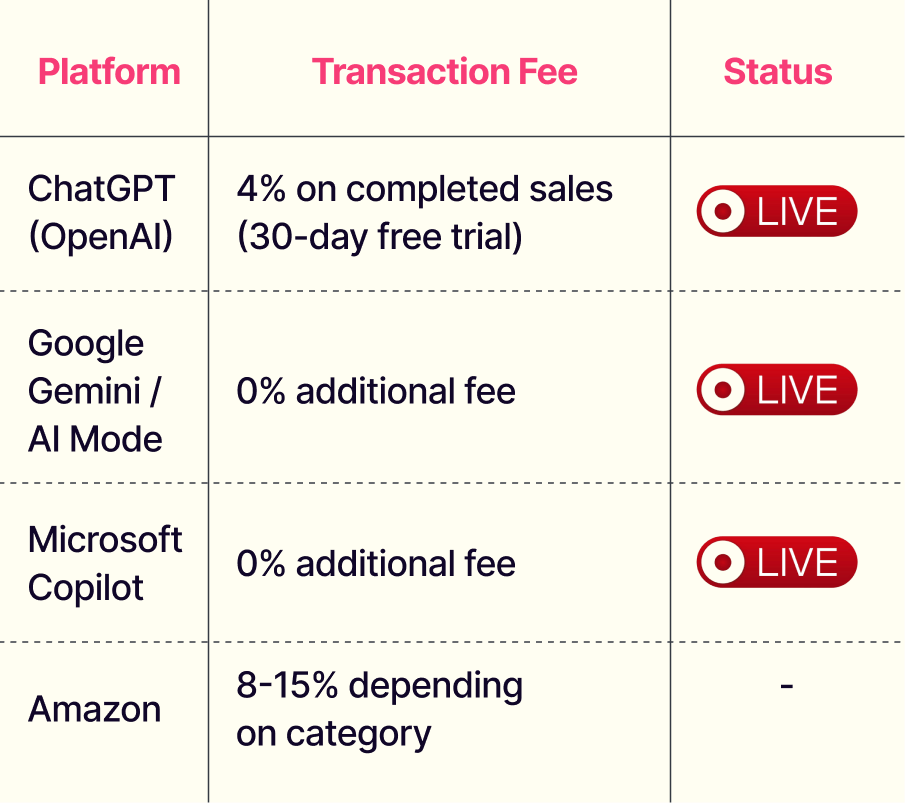
At 4%, ChatGPT is cheaper than Amazon's referral fees but more expensive than Google and Microsoft's current zero-fee AI commerce channels. Google positioned its zero-fee model as a direct competitive response
But the 4% only applies if checkout happens through ChatGPT's flow. If ChatGPT recommends your product and the customer manually types your URL later to buy, no fee.


In January 2026, at NRF, Google and Shopify co-built Universal Commerce Protocol (UCP). It’s a common language that lets ANY AI agent talk to ANY store's backend. Discovery, cart, checkout, and post-purchase are all standardized.
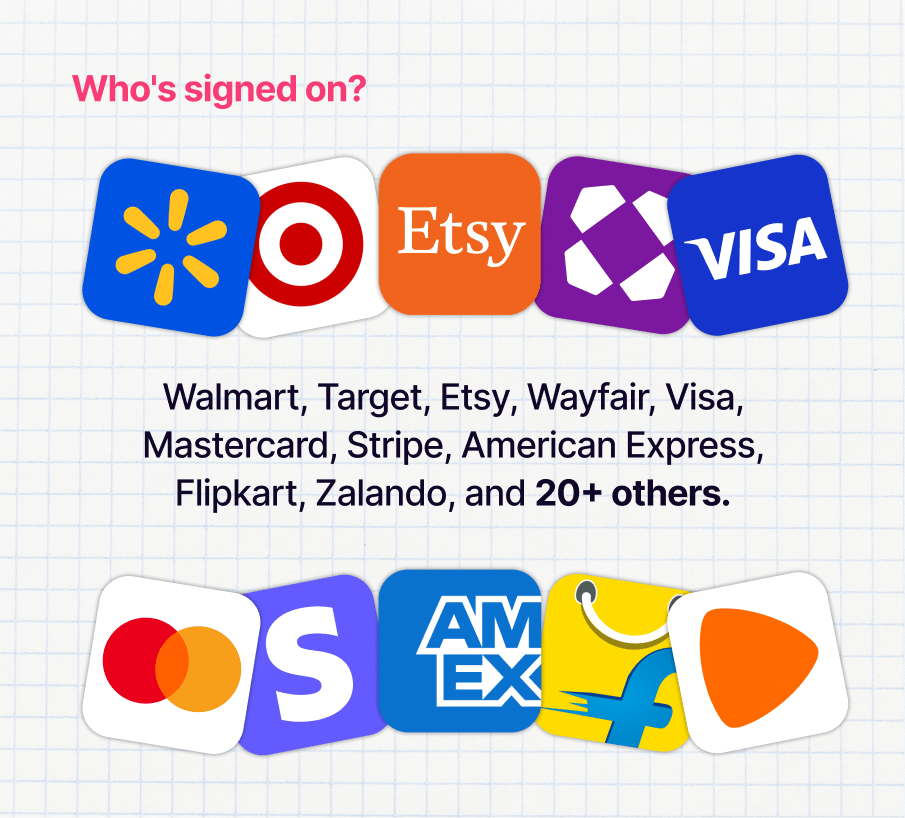
This isn't "Shopify's thing." This is infrastructure. Like how HTTP made the web work, UCP is making AI commerce work. The protocol is explicitly designed to expand into India, Indonesia, and Latin America.
Your Flipkart catalog will soon be discoverable in AI conversations too. Not just Shopify stores.
The Amazon Wildcard (And Why You Should Be Watching This)
Amazon hasn't joined UCP. They're building their own ecosystem.
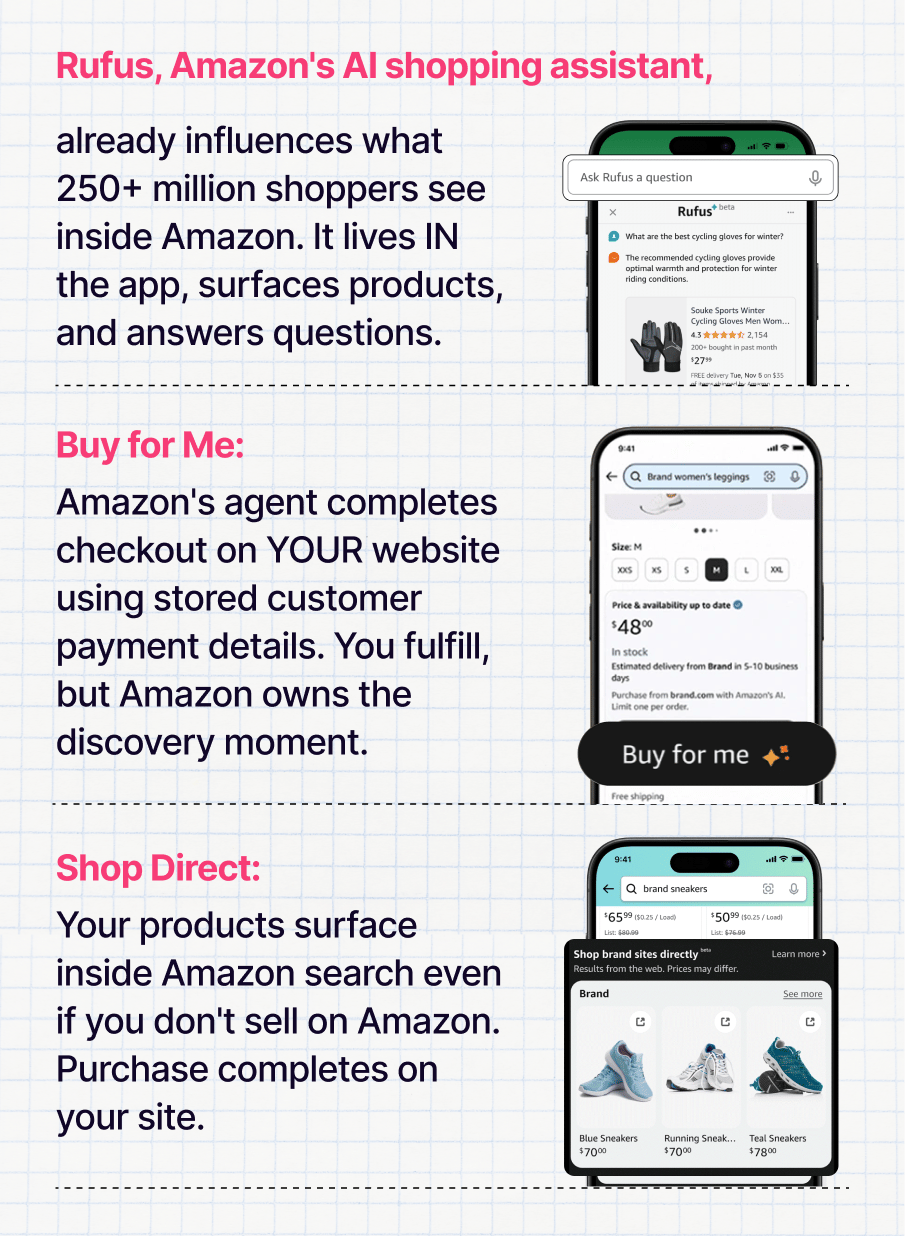
And in February 2026, Amazon invested $50 billion in OpenAI. Days later, ChatGPT's "Instant Checkout" feature (where purchases were completed inside the chat) quietly disappeared. Instead, ChatGPT now redirects to merchant storefronts.
Coincidence? Maybe. Or maybe Amazon just reshaped how ChatGPT does commerce.
Amazon is the only player with the marketplace, the AI, and the checkout infrastructure all in one place. And they're not playing by anyone else's rules.

The Quick Commerce Collision
India's quick commerce market hit ₹11,000 crore monthly GMV. Non-grocery categories are growing 1.6× faster than groceries. Blinkit, Zepto, Swiggy, Instamart, they've trained consumers to expect products in 10 minutes.
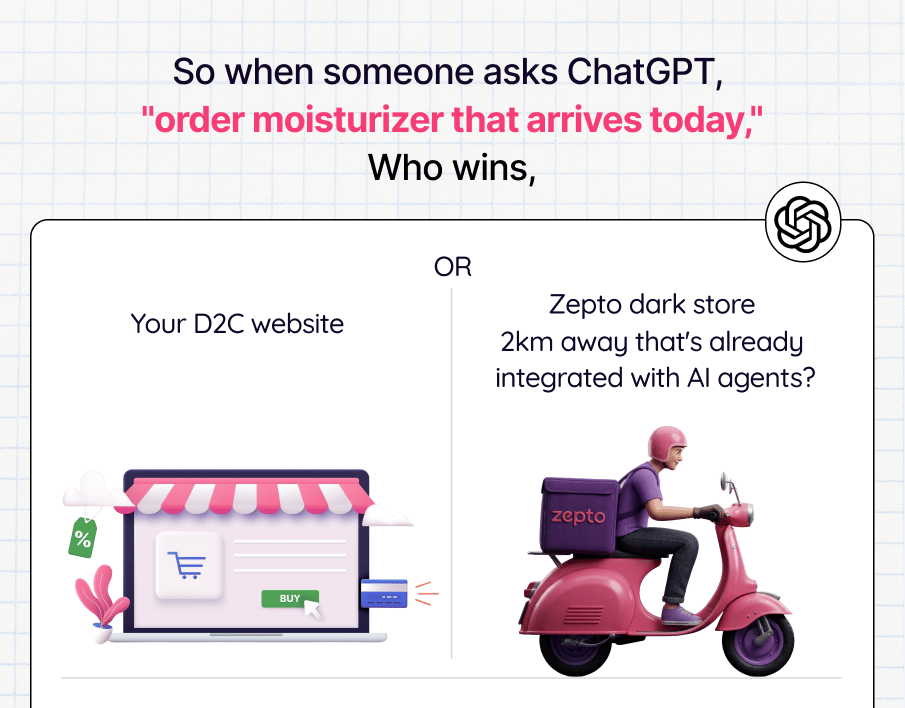
Right now, agentic storefronts can't promise 10-minute delivery. They promise better discovery. That's a different value prop. Indian consumers might choose differently from US consumers.
The COD Problem
Cash-on-delivery is still 40-50% of D2C orders in India. Agentic commerce? Prepaid only. ChatGPT can't hand over cash when the delivery guy shows up.
This is a prepaid-only future. Which means a huge chunk of Indian consumers, especially in Tier 2/3 cities, are locked out. At least for now.
The ONDC Wild Card
India's Open Network for Digital Commerce (ONDC) has pushed the D2C market value to $108.76 billion by democratizing access. Any small seller can list, any buyer can discover.
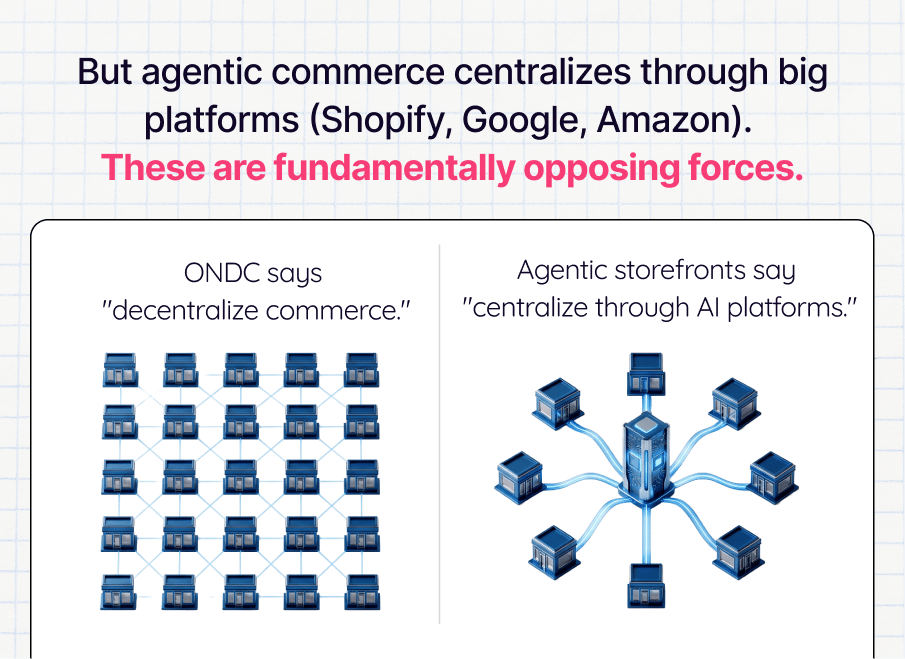
Which future wins in India? We're about to find out.
The Creator Economy Question
Indian D2C is increasingly creator-led. Founders build through Instagram Stories, WhatsApp Communities, and personal connections. Success in 2026 is all about genuine relationships.
But when discovery happens through an impersonal AI interface, how do you maintain that human connection? Does ChatGPT recommend your brand because of your story, or just because your product data is cleaner?
This is a real tension for Indian brands.
Old rules (Google/Instagram era):
Optimize for keywords
Pay for ads
Fight for attention in crowded feeds
New rules (AI era):
Optimize for conversations
Your product data IS your pitch
AI agents decide what to show
What actually matters now:
1. Consistency Across Channels: Your product title, attributes, and pricing must match across Shopify, Amazon, and Flipkart.
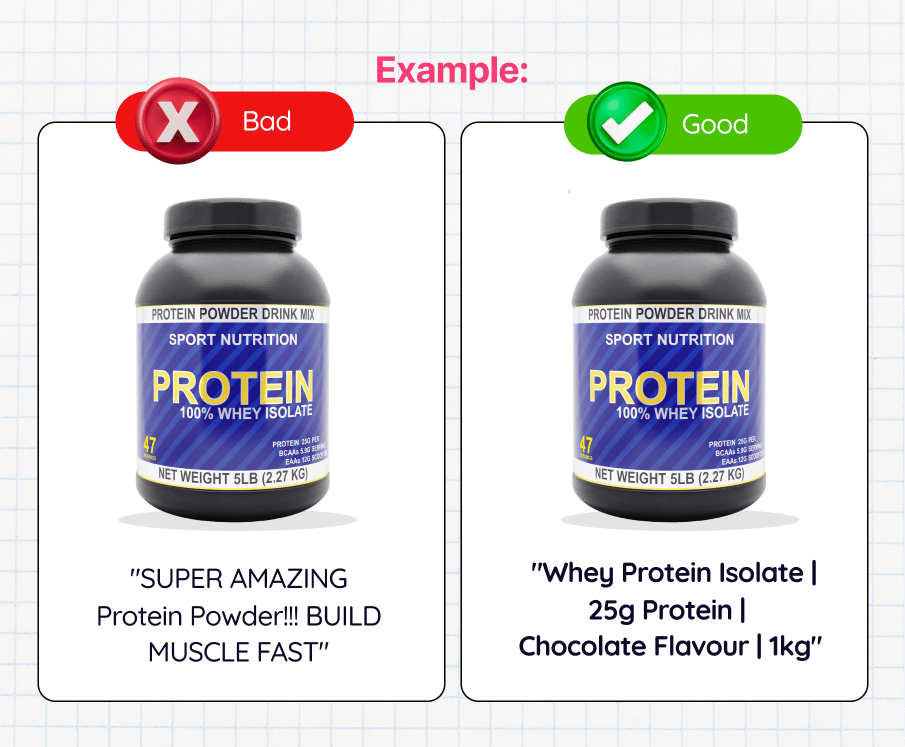
2. Structured Attributes
Ingredients list
Use cases
Sizing charts
Comparison data (vs. alternatives)
Anything your buyer would ask about your product ("is this vegan?", "does this fit size 10?"), Such info should exist in your catalog.
3. Real-Time Inventory Sync: If Shopify says "in stock" but you're sold out, AI agents flag your catalog as unreliable. Use Unicommerce, Eshopbox, or similar multi-channel sync tools. One wrong "in stock" signal can get you deprioritized for weeks.
4. Rich Product Context: Not just specs. WHY should someone buy this?
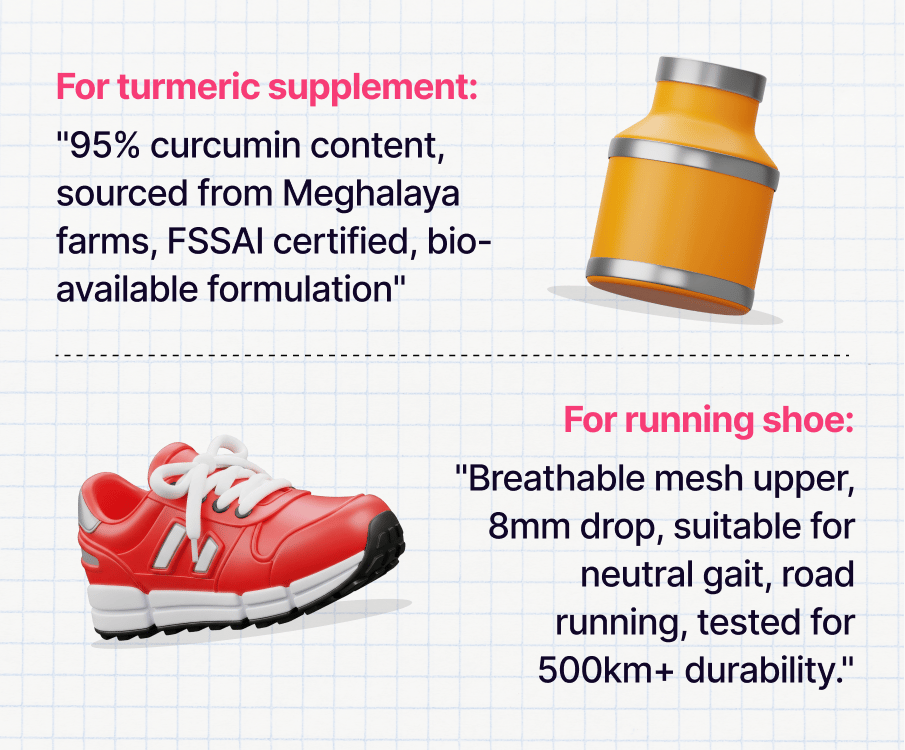
AI can answer "which turmeric supplement has the highest curcumin?" Because your data says so.
Section 5: The Action Plan
If you're on Shopify:
Week 1: Audit
Go to Shopify Admin → Settings → Sales Channels → Agentic Storefronts
It's probably ON by default. Confirm.
Export your product catalog
Check for: inconsistent titles, missing attributes, pricing mismatches
Week 2: Clean
Standardize product titles across ALL channels (Shopify, Amazon, Flipkart)
Add structured attributes: ingredients/materials, dimensions/sizing, use cases, certifications
Remove marketing fluff. Use data. AI doesn't care about "crafted with love." It cares about "100% organic cotton, GOTS certified."
Week 3: Sync
Set up real-time inventory sync (Unicommerce, Eshopbox, or similar)
Test: Change inventory on one channel, verify it updates everywhere within 10 minutes
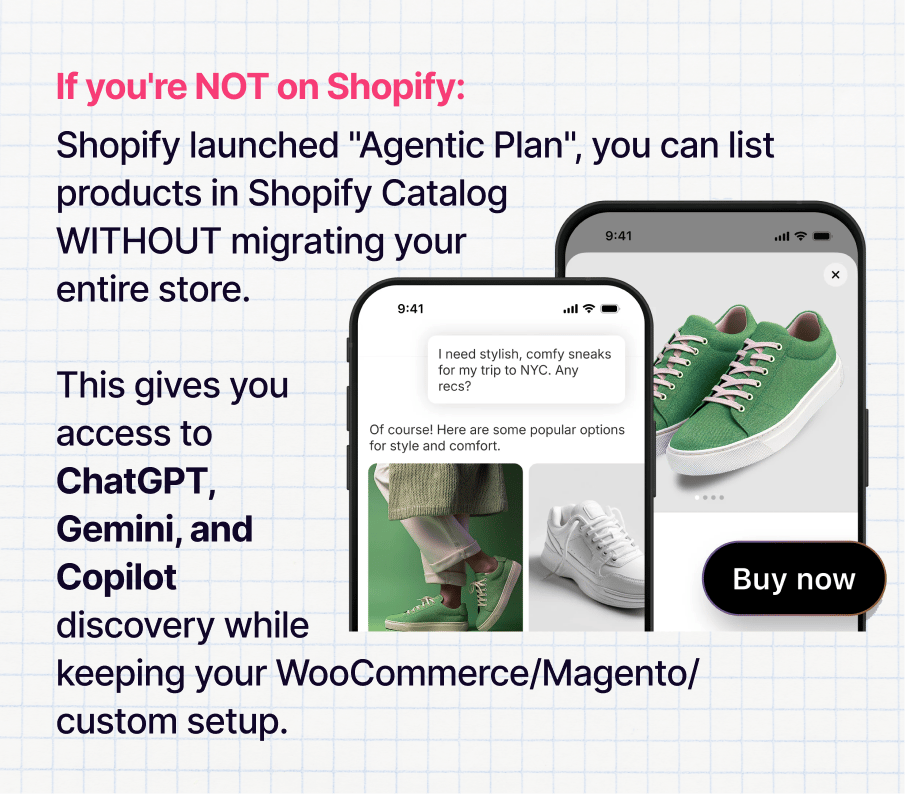
If you're Flipkart-focused:
Start treating your Flipkart catalog like technical documentation, not a landing page. When UCP goes live for Flipkart (soon), the brands with the best data win.
Cost to fix all this: ₹0.
Time required: 2-3 days for an average 50-product catalog.
Closing
For the first time in D2C history, the most important part of your customer journey is happening somewhere you have zero visibility.
This is SEO in 2010 all over again. When Google started ranking websites, brands that understood it early won for years. Same thing here.
Except instead of ranking on Google, you're ranking in conversations where 880 million people are actively shopping.

See you next edition - same time, deeper insights.
Until then, keep building strategically.
Abhishek